 Why Indigenous Understanding Belongs at the Centre of Newcomer Integration
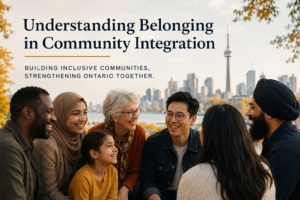

Community Integration
The Missing Phase in Newcomer Settlement
Settlement often focuses on arrival.
Applications are processed. Housing is arranged. Children are enrolled in school. Health cards are issued. Employment workshops begin. Language classes are recommended. People are introduced to systems, services, and procedures intended to help them adapt to life in a new country.
These steps matter. They are essential.
But integration is not the same as arrival.
And increasingly, researchers, community practitioners, and newcomers themselves are pointing to a reality that many systems still struggle to fully recognize: surviving functionally in a country is not the same as feeling connected to it.
Between arrival and long-term stability lies a quieter, largely invisible phase of settlement that receives far less attention than it deserves.
Attachment.
Attachment is the stage where people begin to feel rooted rather than temporary. It is where unfamiliar places slowly become emotionally recognizable. It is where individuals move from simply navigating a country to feeling psychologically and socially connected within it.
And for many newcomers, this phase takes far longer than people assume.
Some never fully reach it at all.
Recent conversations around immigration and settlement in Canada have increasingly acknowledged that integration cannot be measured only through employment statistics, language acquisition, or economic participation. While these indicators remain important, they often fail to capture emotional belonging, social trust, cultural safety, and psychological stability — factors that strongly shape long-term wellbeing and community participation.
A person may have employment and still feel deeply isolated.
A family may appear stable while privately struggling with disconnection.
A young person may speak fluent English while quietly feeling caught between identities, cultures, and expectations.
On paper, settlement may appear successful.
Emotionally, however, many people remain in a prolonged state of transition.
This matters more than many institutions realize.
Research across social integration, migration studies, mental health, and community development consistently shows that social connection is one of the strongest predictors of long-term wellbeing. Individuals who develop meaningful community attachment tend to experience stronger mental health outcomes, greater civic participation, improved resilience, and a stronger sense of future stability.
Yet modern settlement systems are often structured around urgent needs and short-term outputs:
housing secured,
forms completed,
employment obtained,
services delivered.
These are important milestones. But human beings do not build attachment through transactions alone.
Attachment develops through repeated human experience.
It forms gradually:
through trusted relationships,
through familiarity,
through cultural recognition,
through being remembered,
through spaces where people feel emotionally safe enough to exist without constantly explaining themselves.
In many ways, attachment is relational before it is institutional.
And this is where many newcomers experience a profound gap.
Migration itself is not only logistical. It is psychological, social, cultural, and deeply emotional. People often leave behind far more than geography. They leave routines, languages, extended family networks, professional identity, community memory, cultural references, and environments where they once understood how they fit into the world naturally.
Arrival in a new country can therefore produce a strange contradiction:
people may physically arrive long before they emotionally land.
For some, this creates loneliness that is difficult to describe. Not always dramatic loneliness, but a quieter form — the feeling of constantly navigating spaces where nothing feels fully familiar yet.
Even ordinary interactions can become exhausting:
having to explain accents,
translate experiences,
rebuild networks,
learn social norms,
adapt professionally,
and repeatedly prove capability.
Over time, many individuals become highly functional while remaining emotionally unanchored.
This is particularly significant among youth and families.
Young people navigating multiple cultural realities often carry pressures that remain largely invisible to systems around them. Many are balancing family expectations, identity formation, social integration, economic uncertainty, and the emotional realities of watching parents rebuild life under stress.
At the same time, parents themselves are often navigating loss of professional identity, financial pressure, language adaptation, and concern about whether their children will feel a stronger sense of belonging than they do.
These experiences do not always present as crisis.
Often they appear as quiet emotional fatigue.
And because newcomers are frequently expected to demonstrate resilience and gratitude, struggles related to attachment are sometimes minimized or overlooked altogether.
But belonging is not a luxury outcome.
It is foundational to long-term integration.
Without attachment, people may continue participating in society while feeling disconnected from it. Communities become places individuals live in, but never fully feel part of.
With attachment, however, something shifts.
People begin investing emotionally in the spaces around them.
They participate more confidently.
They build relationships more naturally.
They contribute more openly.
And over time, they begin seeing themselves not as temporary outsiders navigating a system, but as part of the social fabric itself.
This is why conversations about integration must expand beyond economics and administration alone.
The future of successful settlement in Canada will depend not only on how efficiently people access services, but on whether communities are capable of creating environments where individuals can genuinely connect, participate, and feel recognized as human beings rather than simply service users or labour-market participants.
Because true integration is not merely about helping people enter systems.
It is about helping people rebuild a sense of place within the world around them.
And that process does not happen automatically at the border.
It happens slowly, relationally, and collectively – through trust, familiarity, safety, and human connection over time.
The writer is the Executive Director at Ontario Integration Initiative