
 Why Indigenous Understanding Belongs at the Centre of Newcomer Integration
OII Resource
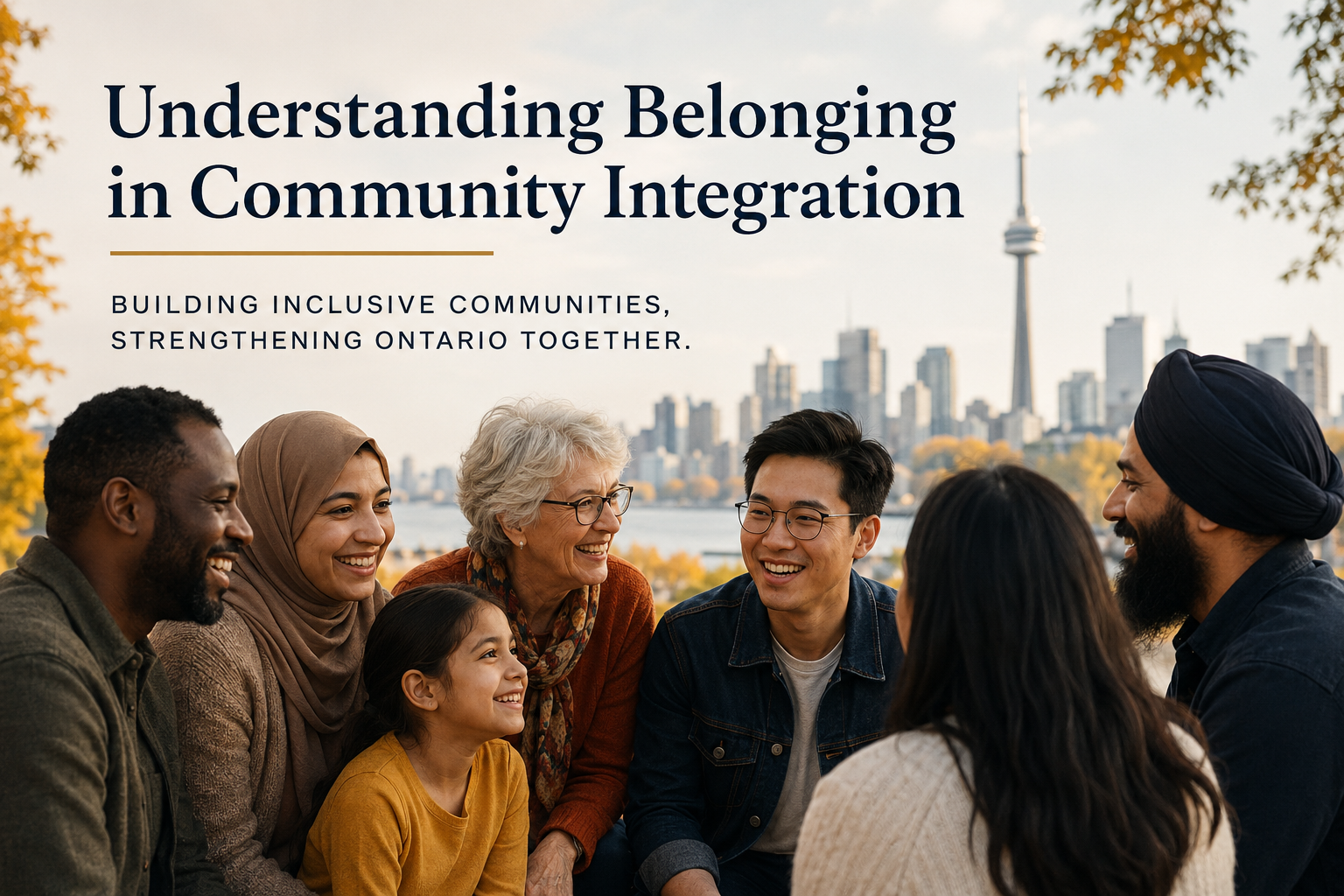
Understanding Belonging in Community Integration
Belonging is a foundational part of successful community integration. While settlement work often focuses on housing, employment, language, and access to services, long-term integration also depends on whether people feel connected, valued, safe, and able to participate in community life. This resource explores belonging as a public health, settlement, and community development issue, drawing from Canadian research, settlement evidence, and practice-informed community experience.
Abstract
Belonging is a foundational part of successful community integration. While settlement work often focuses on housing, employment, language, and access to services, long-term integration also depends on whether people feel connected, valued, safe, and able to participate in community life. This resource explores belonging as a public health, settlement, and community development issue, drawing from Canadian research, settlement evidence, and practice-informed community experience.
Introduction
Belonging is one of the most important but often under-measured parts of community integration. For newcomers, immigrants, refugees, racialized communities, youth, families, and people rebuilding their lives in new environments, integration is not only about finding services. It is also about feeling seen, respected, safe, and connected.
In settlement and community work, the visible needs are often urgent: housing, employment, income, language, school registration, health coverage, food access, transportation, and legal navigation. These needs matter. But they do not fully explain whether a person begins to feel at home in a community.
A person can have a job and still feel isolated. A family can access services and still feel disconnected. A young person can attend school and still feel invisible. This is why belonging must be treated as a core outcome of integration, not as a soft or secondary issue.
Research from Immigration, Refugees and Citizenship Canada notes that sense of belonging is linked to immigrant well-being, and that immigrants may initially report lower belonging to local communities than Canadian-born residents, though this gap often decreases with time in Canada. Statistics Canada has also described sense of belonging to Canada as an important measure of immigrants’ social integration.
For Ontario Integration Initiative, belonging is central to how communities become healthier, more inclusive, and more resilient.
1. Belonging Is More Than Feeling Welcome
Belonging is deeper than being welcomed once. It means people experience ongoing connection, dignity, trust, participation, and recognition.
A welcoming community may greet newcomers. A belonging community makes space for them to contribute.
This distinction matters because integration is a two-way process. IRCC describes integration as a process where newcomers adapt to life in Canada and Canada also welcomes and adapts to newcomers. That means successful integration is not only the responsibility of newcomers. It also depends on institutions, neighbourhoods, service providers, employers, faith communities, schools, municipalities, and residents.
Belonging grows when people can:
- build meaningful relationships;
- access trusted community spaces;
- understand systems and services;
- participate in decisions that affect them;
- contribute skills, culture, leadership, and lived experience;
- feel safe from discrimination and exclusion;
- see themselves reflected in community life.
In this sense, belonging is not simply emotional. It is social, structural, and civic.
2. Why Belonging Matters for Health and Well-being
Belonging is closely connected to health. Social connection is increasingly recognized as a determinant of mental and physical well-being. Recent public health research shows that loneliness and social isolation are associated with serious mental and physical health risks, while social connection supports well-being. The World Health Organization has also highlighted social connection as a major health issue, linking loneliness and isolation to increased risks of depression, anxiety, heart disease, stroke, cognitive decline, and premature death.
For newcomers, these risks can be intensified by migration stress, family separation, credential loss, underemployment, language barriers, trauma, housing instability, discrimination, and unfamiliar systems.
This means belonging should not be treated as a vague community value. It should be understood as part of community wellness.
When people feel connected, they are more likely to:
- seek help earlier;
- trust service providers;
- attend programs;
- share information with peers;
- participate in school and community life;
- build informal support networks;
- experience improved emotional well-being.
A community that promotes belonging is also helping prevent isolation.
3. Settlement Is Not the Same as Integration
Settlement often focuses on immediate adaptation: getting documents, understanding services, finding housing, accessing income supports, enrolling children in school, learning language, or preparing for work.
Integration is longer-term. It includes participation, contribution, identity, trust, relationships, and belonging.
IRCC’s Settlement Program includes Community Connections as one of its main service areas, recognizing the importance of social and community participation. IRCC’s 2023 Settlement Outcomes Report also connects newcomer participation in communities with integration, social cohesion, community engagement, and sense of belonging.
This is important because many programs measure what is easiest to count: number of clients served, referrals made, workshops delivered, or forms completed. These are useful indicators, but they do not fully capture whether people are becoming connected to community life.
OII’s position is that integration should be measured through both practical outcomes and relational outcomes.
Practical outcomes include:
- employment;
- housing;
- access to health care;
- education;
- income stability;
- service navigation.
Relational outcomes include:
- belonging;
- trust;
- social connection;
- confidence;
- participation;
- leadership;
- civic voice.
Both are needed.
4. Community Spaces Are Part of Integration Infrastructure
Belonging often grows in ordinary places: libraries, community centres, churches, mosques, temples, schools, settlement offices, parks, cultural spaces, neighbourhood events, mentorship circles, and volunteer programs.
These spaces may not always be described as “infrastructure,” but they function as integration infrastructure.
They help people:
- meet others;
- ask informal questions;
- learn local norms;
- exchange practical information;
- reduce loneliness;
- form peer support networks;
- build confidence;
- practise language;
- access referrals;
- participate in community life.
Research and settlement practice both point to the importance of social connections. A House of Commons report on improving settlement services noted that Community Connections helps newcomers build social, cultural, and professional interactions while preventing isolation.
For OII, this reinforces the need to design programs that do more than deliver information. Good community programming creates relationships.
5. Belonging and Civic Participation
Belonging also affects whether people feel they have a voice.
When individuals feel excluded, they may avoid public spaces, community meetings, civic processes, volunteering, or leadership opportunities. When they feel included, they are more likely to participate, contribute, and help shape community solutions.
This matters for newcomers and racialized communities because integration is not only about receiving support. It is also about being recognized as contributors.
Civic participation can include:
- volunteering;
- joining local initiatives;
- participating in school councils;
- attending community consultations;
- sharing lived experience;
- mentoring others;
- joining neighbourhood projects;
- contributing to cultural and public events;
- participating in local decision-making.
A belonging-based approach asks not only, “Did people attend?” but also, “Did people feel their presence mattered?”
6. Barriers to Belonging
Belonging is not automatic. Many people face barriers that make connection difficult.
Common barriers include:
- language barriers;
- racism and discrimination;
- lack of transportation;
- lack of childcare;
- unstable housing;
- precarious employment;
- unfamiliarity with Canadian systems;
- trauma or grief;
- social anxiety;
- digital exclusion;
- limited awareness of services;
- fear of being judged;
- lack of culturally responsive spaces.
WoodGreen’s newcomer well-being report notes that many newcomers do not access available services because of limited awareness, uncertainty about how to access supports, and challenges with service coordination. These access barriers also affect belonging: when people cannot easily connect to services, they may also miss opportunities to connect socially.
Belonging therefore requires intentional design. It cannot be left to chance.
7. Practice-Informed Reflections for Community Organizations
From a community practice perspective, belonging is built through repeated, trustworthy, human interactions.
Organizations can strengthen belonging by:
- creating warm first-contact experiences;
- reducing intimidating intake processes;
- using plain language;
- offering culturally responsive programming;
- involving community members in design;
- respecting lived experience as expertise;
- creating peer-to-peer support opportunities;
- building partnerships across sectors;
- following up after events and workshops;
- connecting people to both formal and informal supports.
A one-time workshop may provide information. A well-designed community pathway can create connection.
This is where OII’s model can be strong: combining practical support, wellness, leadership, civic participation, and community-based learning.
8. Recommendations
For community organizations
Design programs that intentionally build relationships, not only attendance. Include time for conversation, peer connection, follow-up, and trust-building.
For funders
Support belonging as a measurable integration and wellness outcome. Fund community spaces, coordination work, outreach, relationship-building, and culturally responsive engagement.
For municipalities
Recognize libraries, community centres, neighbourhood groups, and faith/community spaces as part of local integration infrastructure.
For researchers
Study belonging using both quantitative and qualitative approaches. Numbers matter, but lived experience, trust, safety, and identity require deeper listening.
For service providers
Treat belonging as part of service navigation. A referral is stronger when it connects a person to a trusted relationship, not only a phone number or website.
Conclusion
Belonging is not a luxury in integration work. It is a foundation.
People integrate more fully when they are able to access services, build relationships, participate in community life, and feel that their identity and contribution are valued.
For newcomers and communities experiencing exclusion, belonging can reduce isolation, support mental health, strengthen confidence, and open pathways to leadership and civic participation.
For communities, belonging creates stronger neighbourhoods, more responsive systems, and healthier public life.
Ontario Integration Initiative understands belonging as both a human experience and a community outcome. Building belonging means building communities where people are not only helped, but also seen, heard, connected, and able to contribute.
References / Sources
- Immigration, Refugees and Citizenship Canada. Sense of Belonging: Literature Review.
- Statistics Canada. 2023. Immigrants’ sense of belonging to Canada by province of residence.
- Immigration, Refugees and Citizenship Canada. Evaluation of the Settlement Program. November 2017
- Immigration, Refugees and Citizenship Canada. 2023 Settlement Outcomes Report.
- Holt-Lunstad, J. Social connection as a critical factor for mental and physical health. 2024
- World Health Organization. 2025. Social connection linked to improved health and reduced risk of early death.
- WoodGreen Community Services. Settlement Integration and the Path to Wellbeing.
- House of Commons Canada. 2019. Improving Settlement Services across Canada.
Suggested Citation
Busonga, E. T. (2026). Understanding Belonging in Community Integration. Ontario Integration Initiative.