 Why Indigenous Understanding Belongs at the Centre of Newcomer Integration
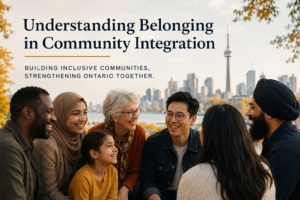

Community Integration
Newcomers in Canada: Challenges, Changes, and the Role of Community-Centred Support
Canada has long welcomed newcomers – and as settlement rates remain high, the experience of arriving in a new country is evolving. New challenges have emerged, but so have opportunities for community-based support that bridges gaps the larger system sometimes misses.
Changing Landscape: What Recent Data Tells Us
- A 2025 report indicates that Canada continues to prioritise economic immigration: by 2027, nearly 65% of new permanent residents are expected to support labour-market needs (Govt of Canada).
- Despite this, many immigrants continue to face employment and economic disparities. Research shows that even highly educated newcomers often struggle to find jobs that match their skills or qualifications (Migration Policy Institute)
- A 2024 report from Statistics Canada found that 43% of recent immigrants (admitted in 2005 or later) reported difficulty – “difficult or very difficult” – in meeting their financial needs over the past 12 months, compared to 29% of non-immigrants or longer-settled immigrants. (Statistics Canada)
- For many newcomers, barriers such as foreign credential recognition, lack of Canadian work experience, limited local networks, language challenges, and social isolation remain common obstacles to full integration. (IRCC Minister Transition Binder 2025-05)
These realities remind us that being “in Canada” does not automatically mean being “settled.” Structural, social, and economic factors often determine whether newcomers can truly thrive.
Growing Strains on the System – and What That Means for Newcomers
Canada’s approach to immigration and settlement is under pressure on multiple fronts:
- The recent federal-level decision to gradually reduce immigration targets over the next few years reflects growing concerns about infrastructure, housing, and social-service capacity. (Migration and Ethnic Relations)
- Public opinion about immigration has become increasingly complex and, in some cases, more critical. According to a 2025 survey, a majority of Canadians (56%) now believe the country accepts “too many immigrants.” (Environics Institute)
- For many newcomers, this shift — both in policy and sentiment — adds uncertainty: housing remains tight, jobs are harder to secure, and social services are stretched.
At the same time, migration and integration remain critical to Canada’s long-term demographics, workforce needs, and social cohesion. (OECD)
What Research Says Works – and Where the Gaps Are
Studies from across Canada indicate some approaches that make integration more successful:
- Programs that combine employer-driven training with skill recognition and bridging initiatives tend to improve employment outcomes for newcomers. (Future Skills Centre)
- Focusing not just on jobs, but also on social support, belonging, and community connection – especially through local networks – helps newcomers navigate systemic challenges and reduces isolation. (LMIC-CIMT)
- Integration is more effective when seen as a long-term journey, not a one-time settlement. Access to ongoing support, connection to social networks, and culturally sensitive resources are central. (refugeehub.ca)
Yet too often, formal systems fall short: credential recognition remains slow; many immigrants – even with university degrees – end up in lower-skill work; and emergency/housing needs may go unmet. (Statistics Canada)
Where OII Fits In: Community-Centred Support That Matters
This is where the work of organizations like OII becomes vital. While national policy and broad programs lay the foundation, grassroots support provides the human connection – often the difference between surviving and thriving.
At OII, we approach integration through multiple interconnected pathways:
- Community & Peer Support Circles – creating safe spaces for newcomers, youth, and families to share stories, find solidarity, and build supportive relationships.
- Bridging Programs – helping participants navigate credential recognition, language challenges, and job-market realities through mentorship, training, and practical support.
- Empowerment & Leadership – giving newcomers opportunities not only to integrate, but to lead, contribute, and shape their communities.
- Holistic Support – addressing emotional, social, and identity-based needs, not just employment or paperwork.
By filling gaps left by large-scale systems, OII works to transform integration from a transactional process into a journey of belonging, dignity, and mutual support.
The Impact We Can Show – and the Work that Remains
Thanks to these efforts:
- Individuals who may have otherwise slipped through cracks have found networks of support, resources for employment, and pathways to meaningful connection.
- Families feel less isolated, newcomers more empowered, and many youth have found a place to build identity and purpose.
- The community as a whole becomes more welcoming, diverse voices are heard, and newcomers contribute – not as burdens, but as full participants.
Still, the structural challenges remain – precarious housing, credential barriers, underemployment, and shifting policies. That’s why the role of community initiatives is more important than ever.
Looking Ahead: What We Should Focus On
To continue building meaningful pathways for newcomers, and to strengthen social cohesion in Canadian communities, we see these priorities:
- Expand bridging and skills-recognition programs that help align newcomers’ credentials and experiences with Canadian labour-market realities.
- Scale community-based support networks – so more newcomers can find belonging, peer support, and collective resources.
- Advocate for policies that recognize integration as long-term – not as a single settlement milestone but as ongoing access to services, connection, and inclusion.
- Promote public understanding and empathy – sharing stories of newcomers’ contributions, challenges, and resilience.
Canada’s future will – and already does – include newcomers. But only if we build systems (both formal and informal) that don’t just relocate people – but help them belong.
At OII, our commitment is to that belonging.